Kelvingrove Art Gallery and Museum
Kelvingrove Art Gallery and Museum
Free admission, major European collections and a suspended Spitfire in the central nave: Kelvingrove Museum is the cultural heart of Glasgow's West End.
Kelvingrove Art Gallery and Museum stands in Glasgow's West End, overlooking Kelvingrove Park. Built in red sandstone in Spanish Baroque style, it houses one of the UK's richest civic collections: European paintings, medieval armour, natural history and Scottish culture sit side by side across two levels. Admission is free, making it an essential stop for any Glasgow visitor.
Practical information at a glance
- Admission: free (some temporary exhibitions may charge)
- Suggested duration: 2 to 3 hours for the permanent collections
- Access: underground metro at Kelvinhall station (circular line), buses from the city centre
- Accessibility: fully accessible building, lifts available
- Rules: no flash on certain artworks; cloakroom available
What you'll see
The permanent collections span a remarkable range. The fine art gallery features works by Rembrandt, Monet, Van Gogh and Salvador Dalí — including the celebrated Christ of Saint John of the Cross. An entire room is dedicated to Charles Rennie Mackintosh and Glasgow's Arts & Crafts movement.
The ground floor houses natural history collections, Egyptian archaeology and armour. A taxidermied elephant and a Spitfire fighter plane suspended from the ceiling of the grand central nave make an immediate impression upon entry.
History and context
The building opened in 1901 for Glasgow's International Exhibition. Designed by architects John W. Simpson and E. J. Milner Allen, it was partly financed by profits from the 1888 Exhibition. Local legend claims the building was constructed backwards — with its main façade facing the park rather than Argyle Street. In fact, the park-side entrance was indeed the originally planned main entrance.
Following a major restoration completed in 2006, the museum reopened with redesigned spaces and modernised displays, attracting over a million visitors annually ever since.
Highlights of your visit
The Christ of Saint John of the Cross
This painting by Salvador Dalí (1951) depicts the crucifixion from above, without nails or blood. Glasgow acquired it as early as 1952, sparking public controversy. It remains the museum's most photographed work.
The central grand nave
The main hall, with its barrel-vaulted ceiling and skylight, houses the Spitfire LA198 suspended in flight. Organ recitals are held regularly here on the Kelvingrove Grand Organ, installed in 1901.
The Mackintosh gallery
Furniture, posters and decorative objects showcase Charles Rennie Mackintosh's work, a central figure in Glasgow's Art Nouveau movement. A natural complement to a visit to the nearby House for an Art Lover.
Historical armour and weapons
The collection of European armour spanning the 15th to 17th centuries is among Écosse's most complete. Helmets, swords and tournament armour are presented in detailed historical context.
Photography tips
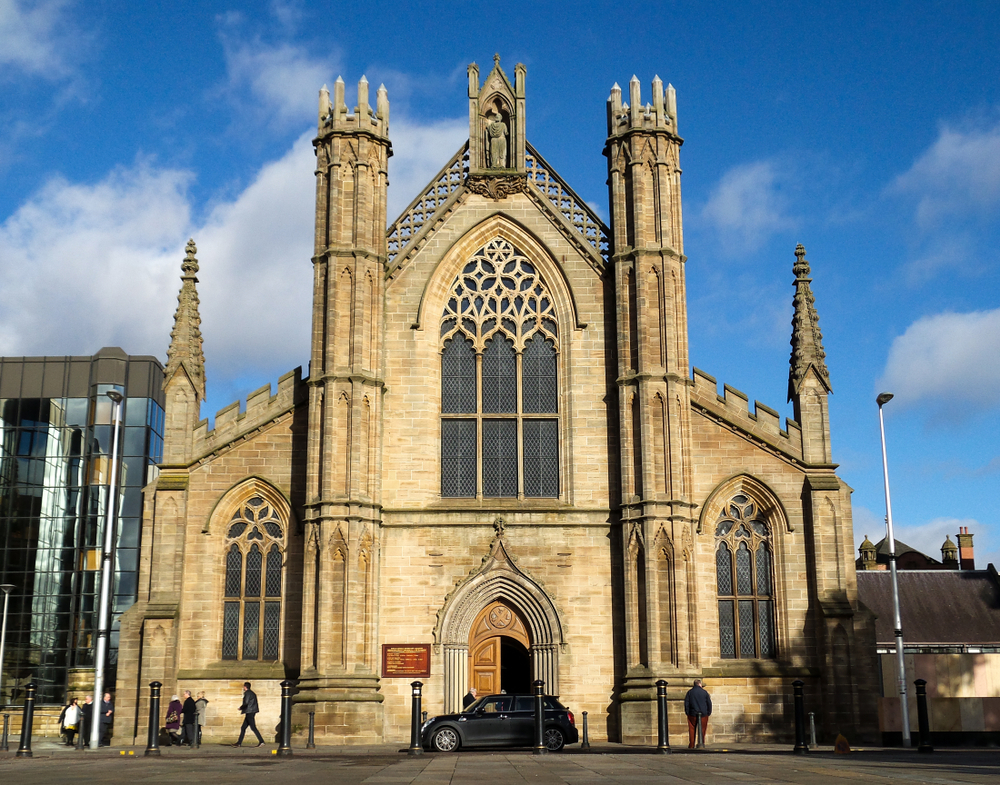
Natural light in the grand nave is optimal mid-morning. The Dalí benefits from dedicated lighting, but flash is forbidden — opt for higher ISO sensitivity. The exterior red sandstone façade photographs best from Kelvingrove Park in late afternoon when raking light emphasises the sculptural relief.
Location and access
The museum sits at the corner of Argyle Street and Kelvin Way, in Glasgow's West End. The underground metro (Kelvinhall station) is a five-minute walk away. From the city centre, several bus routes serve Argyle Street. Kelvingrove Park surrounds the building and offers a pleasant pedestrian approach from Glasgow University.
Nearby
- University of Glasgow — Victorian neo-Gothic campus ten minutes on foot, with its own Hunterian Gallery.
- Kelvingrove Park — urban park following the Kelvin River, ideal for a break between visits.
- House for an Art Lover — villa designed after Mackintosh's plans, a short bus ride away.
- Byres Road — West End shopping street, independent cafés and bookshops just steps from the museum.
Frequently asked questions
Yes, the permanent collections are completely free. Some temporary exhibitions may charge admission; check the programme on the official website before your visit.
Allow two to three hours to tour the permanent collections without rushing. A full day is possible if you wish to attend an organ recital or explore each gallery in depth.
Photography without flash is generally permitted in the permanent collections. Certain copyrighted works may be excluded; signage makes this clear in each room.
Yes. The natural history collections, suspended Spitfire and armour easily capture children's attention. Youth activities and workshops are regularly offered.
The museum pairs naturally with Glasgow University and its Hunterian Gallery, both accessible on foot. The House for an Art Lover requires a short bus or bike ride.
The museum has a café on the ground floor. For wider choice, Byres Road, a few minutes' walk away, offers numerous dining options.
Interested in this visit?
We can include it in your personalised itinerary.