RRS Discovery
RRS Discovery
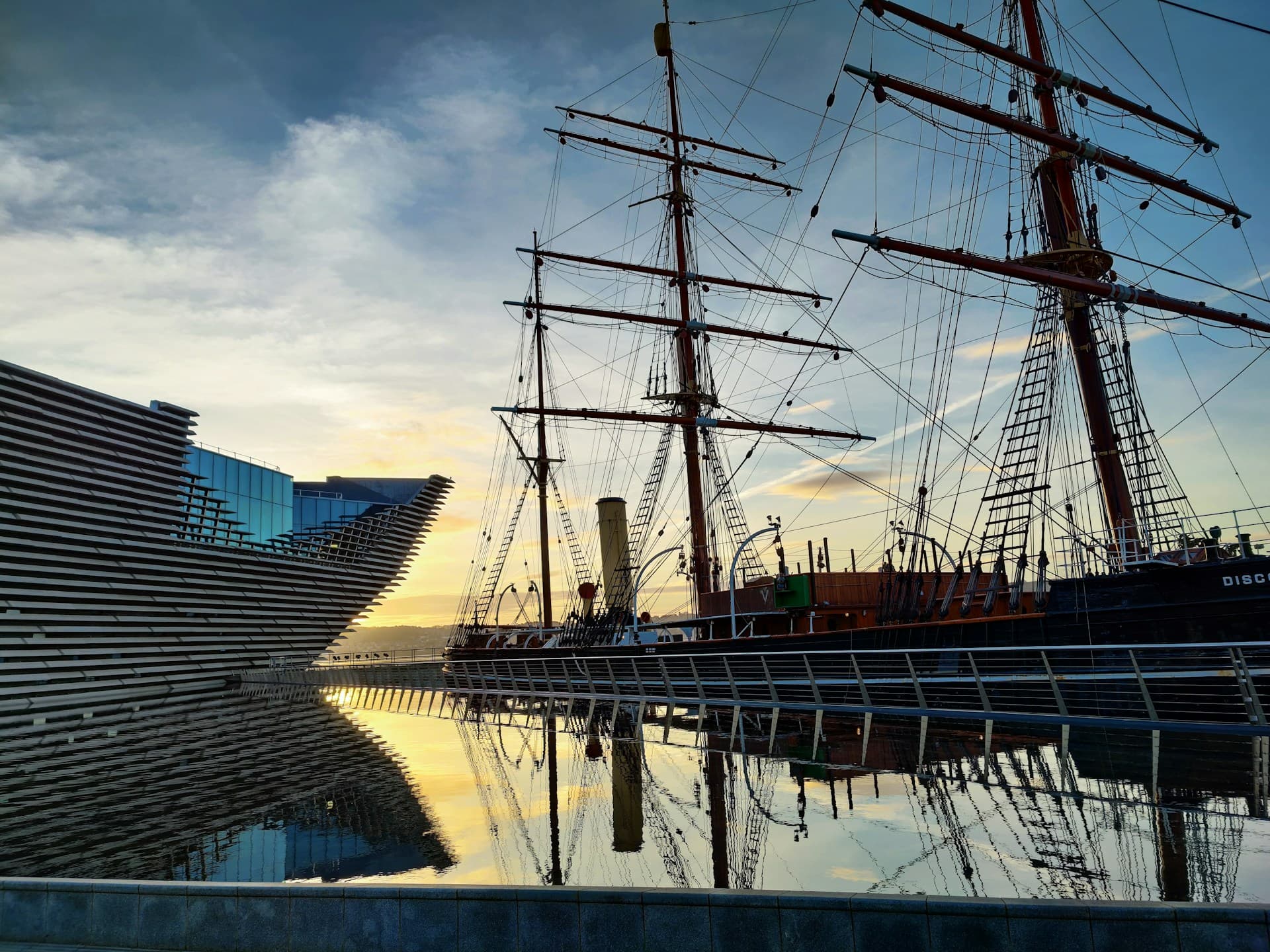
Moored on the banks of the Tay in Dundee, RRS Discovery is the vessel that carried Scott and Shackleton to Antarctica in 1901. An exceptional floating museum, it chronicles the heroic age of polar exploration.
Moored on the banks of the Tay in Dundee, the RRS Discovery is the research vessel that carried Robert Falcon Scott and Ernest Shackleton on the Discovery Antarctic Expedition (1901–1904). Built in Dundee in 1901, it remains one of the last great wooden-hulled sailing ships of the Victorian era. Today a floating museum, it recounts the heroic age of polar exploration with rare documentary precision.
Practical information at a glance
- Admission: paid entry (discounted rates available for children, students, seniors)
- Recommended duration: 1.5 to 2 hours to explore the vessel and exhibition
- Access: Tay waterfront, Discovery Point area, Dundee city centre — on foot from Dundee railway station (approximately 10 minutes)
- Wheelchair accessibility: partial access — the main deck is accessible, but some narrow interior spaces are not
- Dress code: no particular requirements; wear flat-soled shoes for the decks
What to see
The vessel can be explored across several levels. The upper deck displays the original rigging and lifeboats. Moving below, the officers' cabins, dining room and crew quarters are preserved in period configuration. The hold reveals the robustness of the oak and elm wooden hull, engineered to withstand the pressure of pack ice.
The permanent exhibition on shore, in the adjacent Discovery Point building, complements the visit with photographs, ship's logs, polar equipment and testimonies from expedition members.
History and context
Discovery was commissioned by the Royal Geographical Society and the Royal Society for the first British Antarctic expedition of the 20th century. Launched in Dundee in 1901, she spent two winters trapped in the ice of McMurdo Sound. The crew, including Scott and Shackleton, conducted unprecedented scientific surveys of Antarctic fauna, geology and climate.
After the expedition, the vessel served in various commercial and military roles before being rescued from demolition in the 1980s. She returned to Dundee in 1986 and was designated a historic monument.
Highlights of the visit
Scott's cabin
Carefully reconstructed, the Captain's cabin retains period furnishings, instruments and personal effects. It gives a vivid sense of living conditions aboard during Antarctic winters.
The wooden hull
Descending into the hold allows you to observe the double wooden hull — up to 66 cm thick in places — designed specifically to withstand the crushing force of pack ice. A triumph of Victorian naval engineering.
The Discovery Point exhibition
Photographs by Herbert Ponting and handwritten ship's logs on display contextualise the expedition with a depth that the vessel alone cannot convey. Original polar equipment — clothing, sledges, scientific instruments — is particularly evocative.
Photography tips
Natural light is best in the morning, when the sun illuminates the port side across the Tay. The upper deck offers framing with the V&A Dundee in the background. Inside, spaces are narrow and dimly lit: a fast lens or your camera's night mode will be useful. Photography is permitted throughout most of the vessel.
Location and access
RRS Discovery is moored at Discovery Point, on the Tay waterfront, west of Dundee city centre. Dundee railway station is approximately ten minutes' walk away along the water's edge. Parking is available nearby. The site adjoins the V&A Dundee, the design museum that opened in 2018, allowing you to combine both visits in the same half-day.
Nearby attractions
- V&A Dundee — Scottish design museum by Kengo Kuma, a few metres from the vessel.
- Dundee Law — volcanic hill to the north of the centre offering panoramic views over the Tay and Firth of Tay.
- McManus Galleries — Victorian municipal museum dedicated to Dundee's history and arts.
- Broughty Castle — 15th-century fortress at the mouth of the Tay, east of Dundee.
Frequently asked questions
Yes, the visit includes access to the decks, officers' cabins, dining room and hold. Some very narrow spaces may be difficult to access for people with reduced mobility.
Booking is generally not mandatory, but it is advisable during the high summer season and school holidays to avoid waiting.
Absolutely. The two sites are side by side on the Tay waterfront. Allow half a day for each, or a full day for both.
Yes, the vessel is very hands-on and children generally enjoy exploring the decks and cabins. Supervise them in narrow spaces and on the interior ladders.
The site is open year-round. Spring and summer offer the best light for outdoor photography. In winter, visitor numbers are lower and the visit is more peaceful.
Yes, personal photography is permitted throughout most of the vessel and exhibition. No powerful flash is necessary if you use a camera with good low-light sensitivity.
Interested in this visit?
We can include it in your personalised itinerary.