Buachaille Etive Mòr
Buachaille Etive Mòr
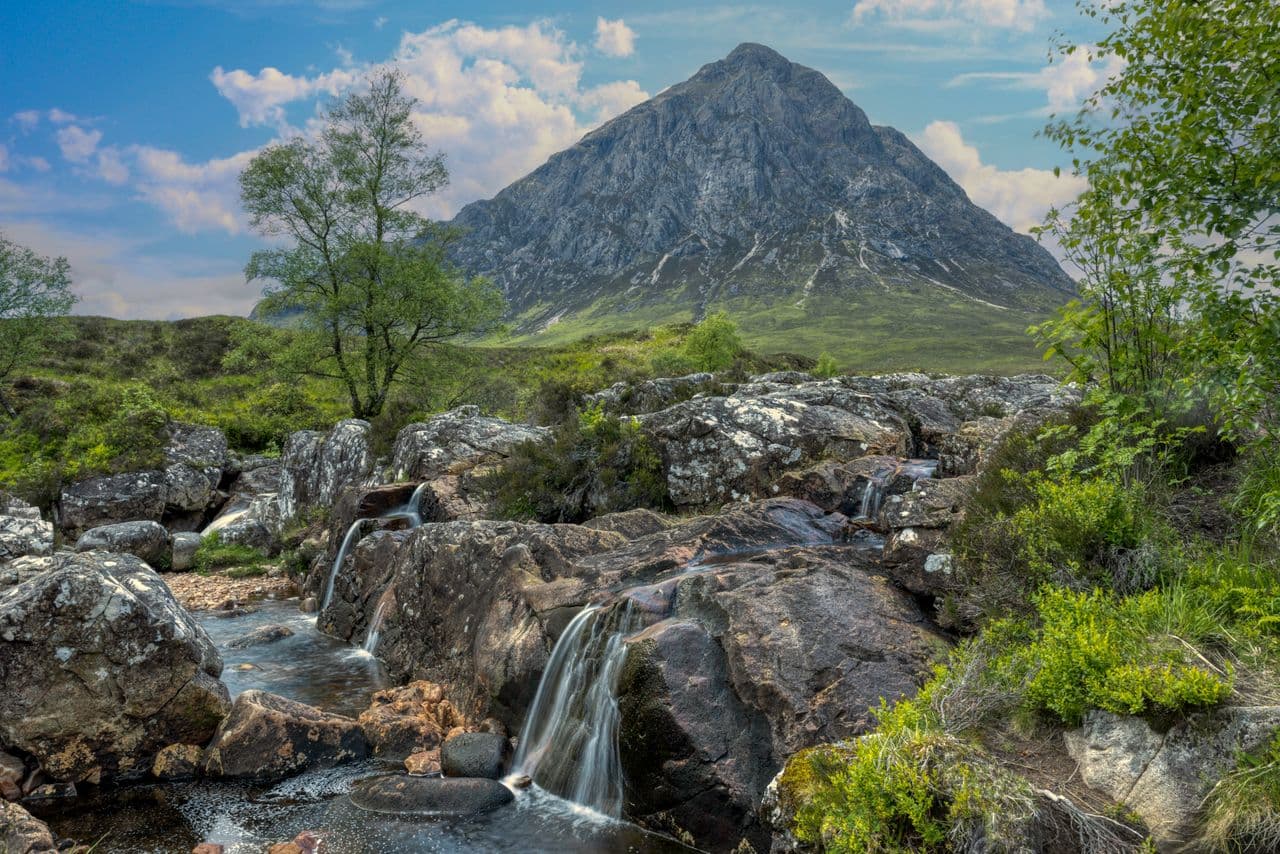
A rocky pyramid dominating the entrance to Glencoe, Buachaille Etive Mòr is the most photographed massif in the Highlands. Hiking, climbing and panoramic views over Rannoch Moor.
Buachaille Etive Mòr — "the great shepherd of Etive" in Gaelic — is a pyramidal massif that dominates the entrance to Glencoe, at the junction of Glen Etive and Rannoch Moor. Its distinctive silhouette, often photographed from the A82, makes it one of the most iconic landscapes in the Highlands. The main summit, Stob Dearg (1,022 m), attracts hikers and climbers year-round.
Practical Information at a Glance
- Access: Altnafeadh car park on the A82, between Glencoe and Bridge of Orchy.
- Entry: free access, no entry fee.
- Recommended duration: 5 to 8 hours for the complete ascent of Stob Dearg; 1 to 2 hours for Coupall gorge without the summit.
- Equipment: mountain gear essential (waterproof boots, layers, waterproof jacket); changeable weather in all seasons.
- Accessibility: the massif is not accessible for people with reduced mobility; the surroundings from the car park offer clear views without walking.
What You'll See
The massif forms a horseshoe of four summits (Munros and Tops) connected by rocky ridges. The northeast face of Stob Dearg presents rhyolite cliffs prized by climbers. Below, the Coupall River cuts through an enclosed gorge before joining the River Etive. Rannoch Moor extends to the east, a vast peat plateau dotted with lochs.
History and Context
Buachaille Etive Mòr is a volcanic formation dating from the Devonian period, shaped by successive glaciations. Historically, it marked the border between Campbell and MacDonald clan lands. The A82 road, built in the 19th century, opened this territory to the first Victorian alpinists. The Scottish Mountaineering Club established Lagangarbh Hut here as early as 1928, a refuge still in use today.
Highlights of Your Visit
The Ascent of Stob Dearg
The classic route starts from Altnafeadh, climbs the Coupall gorge then the Coire na Tulaich gully to the ridge. The climb is steep but non-technical in summer conditions. The summit panorama embraces Rannoch Moor, Ben Nevis and the Mamores.
Coupall Gorge and the Waterfall
For a shorter outing, the trail following the Coupall River from Altnafeadh leads to an enclosed waterfall. Accessible in less than an hour, this section offers a direct view of the massif's northeast face without altitude exposure.
The Four Summits Circuit
Experienced walkers link Stob Dearg, Stob na Doire, Stob Coire Altruim and Stob na Bròige over a long day. The traverse requires solid navigation skills and stable weather conditions.
Photography Tips
Golden morning light illuminates the northeast face from the A82: position yourself at the roadside or on the Coupall riverbank. In winter, snow accentuates the pyramidal geometry of the summit. Avoid midday in summer, often hazy. A telephoto lens (70-200 mm) isolates the rocky pyramid from Rannoch Moor.
Location and Access
Buachaille Etive Mòr lies approximately 12 km northeast of Glencoe and about 45 km south of Fort William. Altnafeadh car park (A82) is the main starting point. Scottish Citylink buses connecting Glasgow to Fort William stop nearby on request. No wheelchair access to the massif itself; the view from the car park remains clear.
Nearby Attractions
- Glencoe — glacial valley marked by the 1692 massacre, with trails and NTS visitor centre.
- Rannoch Moor — wild peat plateau extending to the east, crossed by the West Highland railway line.
- Glen Etive — enclosed valley south of the massif, made famous by the film Skyfall, accessible by narrow road.
- Buachaille Etive Beag — "little shepherd", neighbouring ridge less frequented offering a direct view of the great massif.
- Ben Nevis — highest peak in the British Isles (1,345 m), approximately 45 km to the north.
Frequently asked questions
May to September offers the most favourable conditions. In winter, snow and ice make the ascent technical; crampons and ice axe become necessary.
Stob Dearg via the Coire na Tulaich gully is accessible to hikers in good physical condition, but the gradient is sustained and ridge navigation requires attention. Some mountain hiking experience is recommended.
Yes. Glencoe village and visitor centre are about fifteen minutes' drive away. One day is enough for the Buachaille ascent; a second day allows you to explore the trails in Glencoe valley.
No restrictions. The site is in open countryside, managed by the National Trust for Scotland. Photography is free anywhere on the massif.
Altnafeadh car park on the A82 is the usual starting point for Stob Dearg. A second access via Glen Etive allows you to reach the massif's southern summits.
The Highlands are renowned for rapid changes: mist, rain and wind can occur within minutes even in summer. Check the Mountain Weather Information Service (MWIS) before any ascent.
Interested in this visit?
We can include it in your personalised itinerary.