Duart Castle
Duart Castle
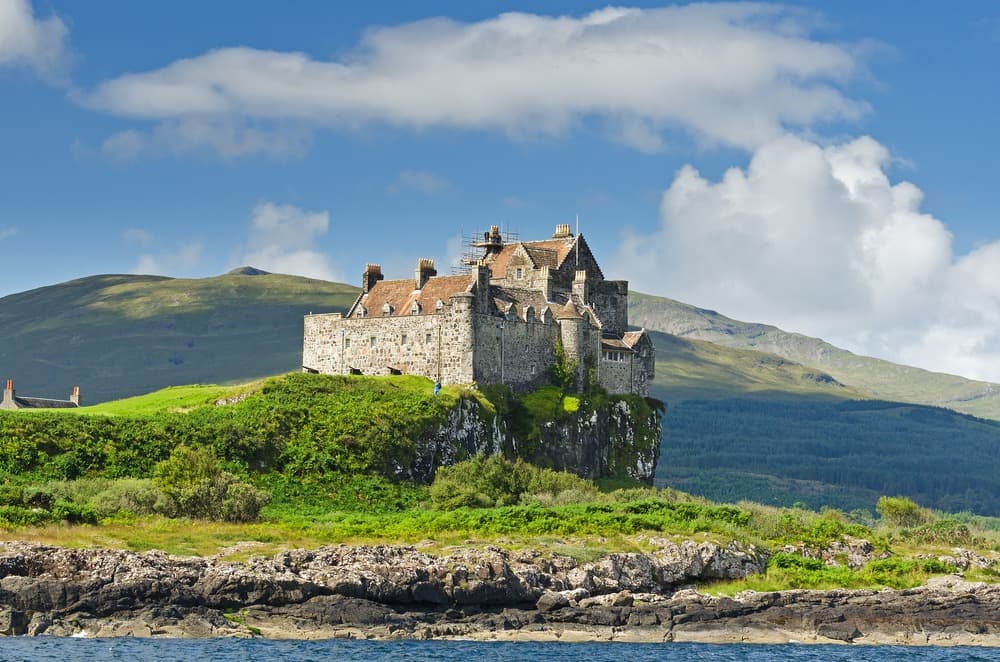
On the Isle of Mull, Duart Castle is the historic seat of Clan MacLean since the 14th century, strategically positioned overlooking the Sound of Mull.
On the east coast of the Isle of Mull, facing the Sound of Mull strait, Duart Castle occupies a rocky promontory that has commanded the maritime routes of the Inner Hebrides for seven centuries. Historic seat of Clan MacLean, the fortress combines defensive function, family heritage and museum collections, all set within an expansive landscape of the western Highlands.
Why visit Duart Castle
Duart stands out among Scottish castles for the unbroken occupation by the same clan: the MacLean have held it since the 14th century and remain its owners today. The visit offers several compelling attractions:
- Clearly legible medieval military architecture, featuring a 16th-century keep with walls three metres thick.
- A remarkable strategic position commanding the channel between Mull and the mainland, controlling access to Lochs Linne and Etive.
- Family collections spanning portraits, coats of arms, 19th-century photographs and military uniforms dating from 1750.
- An expansive panorama over the Firth of Lorn, the Morvern mountains and, on clear days, Ben Nevis itself.
History of the castle and Clan MacLean
The fortress is believed to have been built by Clan MacDougall in the 13th century before passing to the MacLean in the following century. In 1350, it became part of the dowry of Mary MacDonald, daughter of John of Islay, Lord of the Isles, upon her marriage to Lachlan Lubanach Maclean of Duart, 5th chief of Clan MacLean. In 1390, Donald MacDonald, Lord of the Isles, formally confirmed MacLean rights to the castle by charter.
The civil wars of the 17th century left an indelible mark on the site. In September 1653, a Cromwellian fleet of six ships arrived before Duart; the MacLean had already withdrawn to Tiree. On 13 September, a violent storm caused the loss of three vessels, including the HMS Swan. The protected maritime heritage zone north of the castle harbours the presumed wreck of the Swan, studied by underwater archaeologists.
In 1678, Archibald Campbell, 9th Earl of Argyll, invaded MacLean lands. Sir John Maclean, 4th Baronet, was forced to surrender Duart to the Campbells, who ordered its partial demolition. The castle lay in ruins for more than two centuries. In 1801, the Campbells sold it to Clan MacQuarrie; it subsequently passed to the Carter-Campbells of Possil, then to A. C. Guthrie in 1865.
The MacLean's return came in 1911, when Sir Fitzroy Donald Maclean, 26th chief of the clan, purchased the fortress and undertook its restoration. In the 20th century, Charles Maclean, 27th chief, led the Boy Scouts Association of the United Kingdom from 1959 to 1971 and Commonwealth Scouting until August 1975, which explains scouting's prominence in the museum display. In 2012, the family announced it could not fund restoration work alone; a fundraising appeal was launched and the 7th restoration phase was completed in 2020.
Duart has also served as a film location: the film I Know Where I'm Going! was shot there in 1945, and several scenes from Entrapment (1999) starring Catherine Zeta-Jones and Sean Connery — the latter of MacLean descent — were filmed at the castle.
What to see inside
The keep and defences
The 16th-century keep preserves walls three metres thick, designed to withstand the artillery of the period. Its position overlooking the channel made it an effective stronghold for controlling maritime traffic between Mull and the mainland.
The great hall
It houses the portraits and coats of arms of Clan MacLean, visual aids for understanding the genealogy of successive chiefs.
The state chamber and adjoining rooms
The dressing rooms and neighbouring spaces display a collection of family photographs spanning the mid-19th century to the present day, alongside military uniforms and dress dating from 1750.
The exhibition room at the summit
It traces the history of clan chiefs and features tapestries and commemorative objects linked to scouting, reflecting Charles Maclean's role in the British and Commonwealth Scout movement.
Practical information
- Duration of visit: allow 1.5 to 2 hours for the interior, longer if exploring the surrounding grounds.
- Admission: paid entry at a modest rate, with family and children discounts. The exterior grounds are freely accessible.
- Facilities on site: tearoom and gift shop open in season.
- Accessibility: sloping terrain and historic staircases inside; wear appropriate footwear.
When to visit
The castle, tearoom and shop are open from late March to mid-October, with hours varying by month — check the official calendar before your visit. The exterior grounds remain accessible year-round: you can admire the castle's silhouette and strategic setting even outside the season.
The most comfortable period runs from May to September, when days are long and weather more stable. May, June and September offer an excellent balance of daylight, moderate crowds and fewer midges, the biting insects typical of the Highlands in peak summer.
How to get there
The castle sits on the east coast of the Isle of Mull. You must first reach the island by CalMac ferry from the mainland.
- From Oban: ferry to Craignure, approximately 10 minutes' drive from the castle. This is the most convenient route for those coming from Edinburgh or Glasgow.
- From Lochaline (Morvern peninsula): ferry to Fishnish, approximately 20 minutes' drive from the site. A worthwhile option if travelling down from Fort William via the coastal road.
- On the island: a personal car is recommended, as Mull has limited public transport. Signposting to Duart Castle is clear from Craignure.
What to see nearby
The Isle of Mull and its surroundings contain several complementary sites:
- Tobermory, Mull's colourful capital, approximately 1 hour's drive to the north.
- Iona, a small monastic island accessible by ferry from Fionnphort, the birthplace of Celtic Christianity in Écosse.
- Staffa and Fingal's Cave, basalt formations accessible by boat excursion from Mull.
- To further explore Highland clan fortresses, Dunvegan Castle and gardens on the Isle of Skye offer an interesting parallel as the seat of Clan MacLeod.
Frequently asked questions
Frequently asked questions
Yes, it has belonged to the MacLean family since its purchase in 1911 by Sir Fitzroy Donald Maclean, 26th chief of the clan, and remains their ancestral seat. Part of it is open to the public in season.
Allow 1.5 to 2 hours for the castle and its collections. Adding the tearoom and a walk around the promontory, plan for a half day.
No. The interior, tearoom and shop open from late March to mid-October, with hours varying by month. The exterior grounds remain accessible year-round.
It is possible but inconvenient. Ferries arrive at Craignure (10 minutes) or Fishnish (20 minutes); a car, taxi or seasonal shuttle service remain the simplest options to reach the castle.
The castle appears in I Know Where I'm Going! (1945) by Powell and Pressburger, and in several scenes of Entrapment (1999) starring Catherine Zeta-Jones and Sean Connery.
Including Duart in your Écosse itinerary
Duart Castle naturally fits into a Highlands and Hebrides circuit combining Oban, Mull, Iona and Skye. To build a custom itinerary incorporating the west coast and its clan sites, explore our Écosse travel suggestions.
Interested in this visit?
We can include it in your personalised itinerary.