Eilean Donan Castle
Eilean Donan Castle
An iconic Highland fortress perched at the junction of three sea lochs, Eilean Donan combines medieval history, 20th-century reconstruction and cinematic scenery.
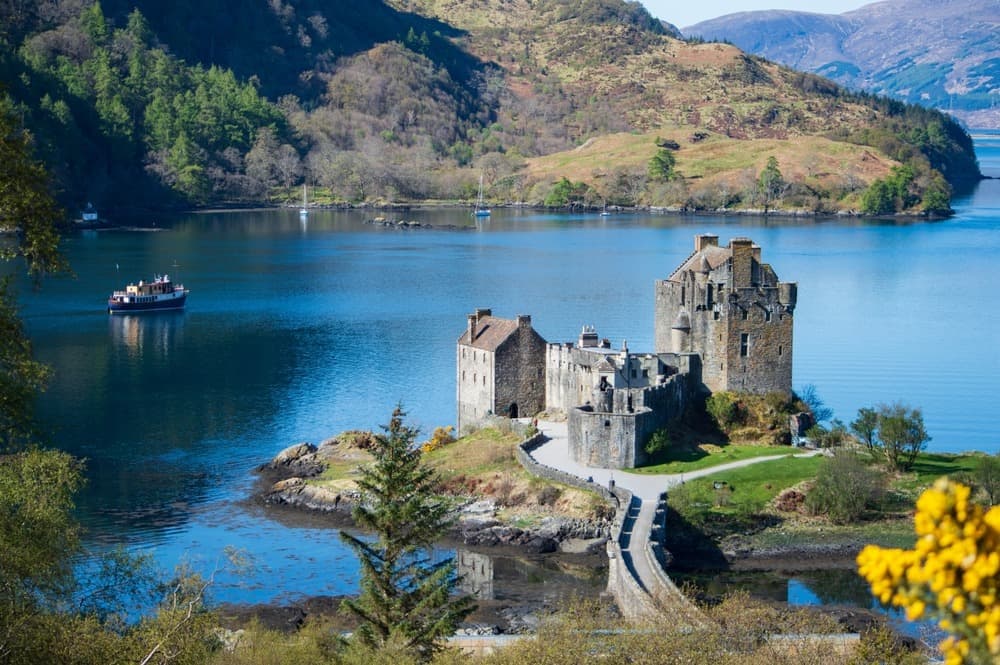
Positioned on a rocky islet at the junction of three sea lochs — Loch Duich, Loch Long and Loch Alsh — Eilean Donan Castle is one of the most photographed sites in Scotland. Connected to the mainland by an arched stone bridge, it encompasses nearly eight centuries of Western Highlands history, spanning medieval fortress, Napoleonic ruin and 20th-century reconstruction.
Why visit Eilean Donan
- An iconic Highland silhouette, midway between Inverness and the Isle of Skye
- Fully furnished interior: banqueting hall, reconstructed kitchens, chambers and MacRae family collections
- Dense history, from Robert the Bruce's refuge to the 1719 bombardment
- Notable cinematic presence (notably Highlander and The World Is Not Enough), which made it a visual icon
- Remarkable natural setting, ideal for photography at sunrise or sunset
History
The island takes its name from Donan of Eigg, an Irish bishop who came to Scotland around 580 to evangelize the Celts. The castle itself was built in the early 13th century. Its foundation is attributed either to King Alexander II, who sought to strengthen resistance against Norwegian raids, or to Farquar II, founder of the line of Earls of Ross.
After several phases of expansion, the structure eventually covered the entire islet. By the late 14th century, for reasons that remain unclear, it was reduced to a fifth of its maximum size. Legend has it that the future King Robert I (Robert the Bruce), hunted by the English, found refuge here and prepared his reconquest of the throne.
The castle also played a role in local rivalries, notably between the MacRaes and the MacDonalds. Its fate turned in 1719, during the War of the Quadruple Alliance: a Spanish garrison of around forty soldiers, sent to support the Stuart claimant, entrenched themselves here. Three British frigates bombarded the stronghold and, after three days of resistance, the castle was largely destroyed.
The islet lay abandoned for nearly two centuries. In 1911, John MacRae-Gilstrap purchased the ruins and initiated clearance work in 1912 to recover the foundations. Proper reconstruction began in 1920 and was completed in 1932, a twenty-year undertaking. Notably, the castle's original plans were not discovered in Edinburgh Castle archives until after the work was finished. Comparison revealed the restoration to be remarkably faithful to the original structure.
The MacRae family retained ownership throughout the 20th century. In 1983, the Conchra Charitable Trust was established to oversee management, maintenance and restoration of the site. By 2005, the castle welcomed 270,822 visitors, surpassing Urquhart Castle on the shores of Loch Ness.
What to see on site
Access is via the stone bridge on the south side, through a modern gateway equipped with a portcullis. Above the passage, an inscription in Gaelic is topped with the coat of arms of John MacRae-Gilstrap. The gateway opens onto a courtyard whose level has been lowered to expose the rocky base surrounding the keep.
The southeastern buildings echo the form of earlier structures, featuring a characteristic circular staircase tower, though in more generous volumes. To the southwest, only the southern part of the L-shaped block has been reconstructed, as a three-storey house; the northern wing has given way to an open platform overlooking the loch. A small tower occupies the northwest corner.
The keep respects original dimensions. The ground floor, formerly partitioned, now forms a single room. On the first floor, the banqueting hall is the most impressive space: oak ceiling decorated with coats of arms, 15th-century fireplace, period furnishings. The main beams are Douglas fir, shipped from British Columbia as a gift from Canadian MacRaes. Small mural chambers, set within wall thickness, are accessible from each room.
Practical information
The castle is open for much of the year, with extended winter closure. Hours vary by season: it is advisable to check opening days and times on the official website before visiting.
Admission is moderate, with full adult entry around ten pounds and reductions for children, students and families. Tickets are purchased at the visitor centre on site; online booking is now available and recommended during peak season.
Allow 1 to 1.5 hours for the interior visit, longer if you take time to photograph the exterior from various angles. The visitor centre houses a shop and café.
When to visit
The period from May to September remains most favorable, with long days and light that showcases the site. July and August, however, draw peak crowds: for photos without crowds, prioritize early morning or late afternoon opening.
Spring (April-May) offers lush landscapes and moderate visitor numbers. Autumn (September-October) plays on Highland colors, with more unsettled weather. In winter, the castle is closed part of the season but remains spectacular from the outside, sometimes dusted with snow.
How to get there
- From Inverness: approximately 130 km via the A82 then A87 toward Skye, allow 2 hours driving
- From the Isle of Skye: approximately 15 km from the Skye bridge via the A87, about twenty minutes
- From Fort William: approximately 110 km via the scenic Glen Shiel route
- By train: the nearest station is Kyle of Lochalsh, terminus of the scenic line from Inverness, about ten kilometers from the castle
- By bus: Citylink services link Inverness, Fort William and Portree with stops nearby
Nearby
Eilean Donan lends itself well to a combined itinerary in the western Highlands:
- Kyle of Lochalsh and the Isle of Skye about twenty minutes away, with Dunvegan Castle, seat of Clan MacLeod
- The Glen Shiel valley, site of the 1719 battle, on the route from Fort William
- Loch Ness and Urquhart Castle, on the return route to Inverness
- To extend toward the capital, the Royal Mile, Arthur's Seat or Holyrood Palace in Edinburgh
Frequently asked questions
Frequently asked questions
Include Eilean Donan in your trip
Eilean Donan is best visited as part of a circuit connecting Inverness, the Western Highlands and the Isle of Skye. To plan a bespoke itinerary incorporating this castle and other sites in the region, consult our Scotland trips.
Interested in this visit?
We can include it in your personalised itinerary.