National Museum of Scotland
National Museum of Scotland
Free admission, twelve million objects and a spectacular Victorian glass house: the National Museum of Scotland is one of Edinburgh's most comprehensive visits, just steps from the Royal Mile.
The National Museum of Scotland occupies a golden sandstone Victorian building in the heart of Edinburgh, just steps from the Royal Mile. It houses more than twelve million objects covering natural history, sciences, decorative arts and Scottish history from prehistory to the present day. Admission is free, making it one of the most accessible visits in the capital.
Quick practical information
- Admission: free (temporary exhibitions may charge)
- Suggested duration: 2 to 4 hours depending on galleries chosen
- Access: Chambers Street, a few minutes' walk from Waverley Station
- Wheelchair accessibility: wheelchair access, lifts available in both buildings
- Dress code: no restrictions
What you'll see
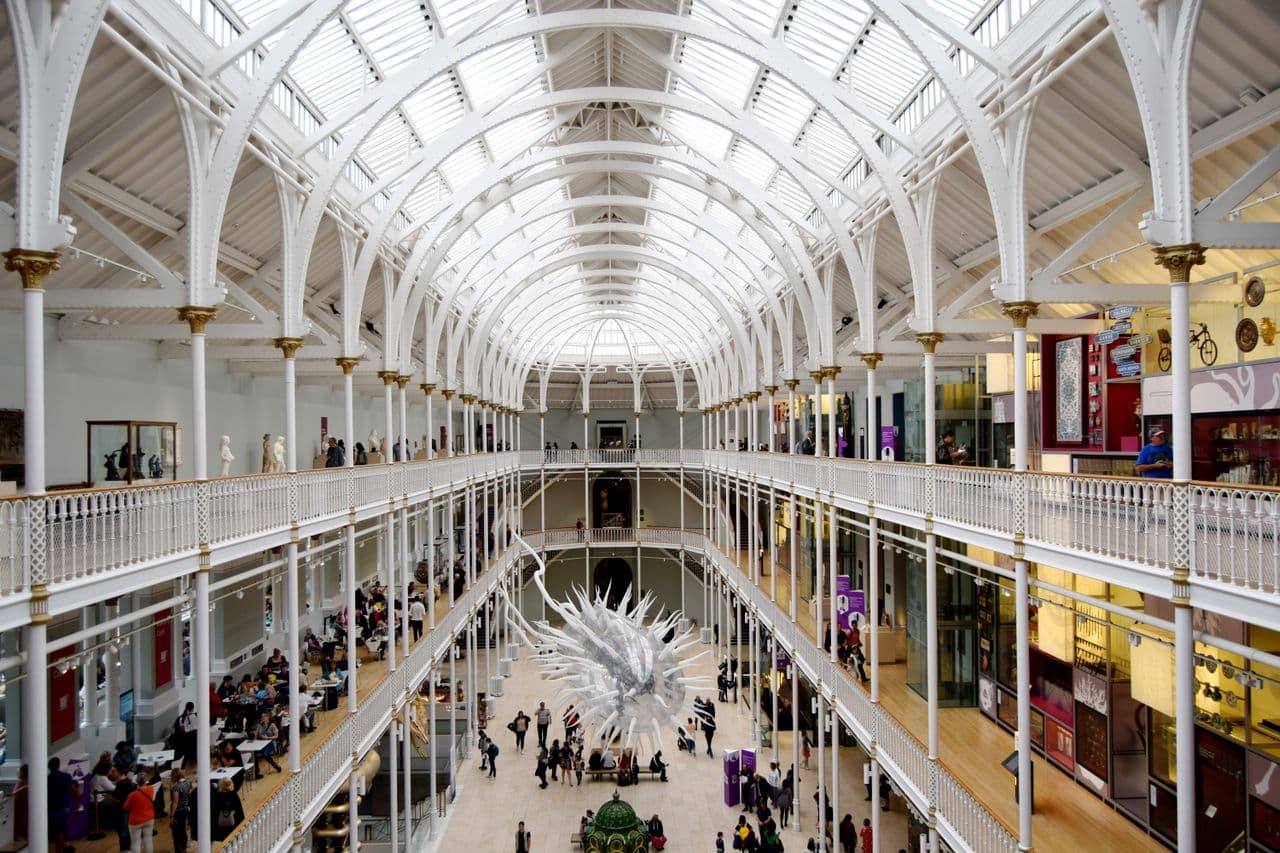
The museum is divided into two linked wings: the 1866 Victorian building (Royal Museum) and the contemporary sandstone extension from 1998. The galleries cover Scottish geology and wildlife, ancient world civilisations, European decorative arts, industrial history and sciences. The grand central glass house of the Victorian building remains one of Edinburgh's most spectacular interior spaces.
History and context
The Royal Museum opened in 1866 on Chambers Street, designed by Francis Fowke in an Italian Renaissance style adapted to cast iron and glass. The Scotland-dedicated wing, inaugurated in 1998 and designed by Benson + Forsyth, embraces a decidedly contemporary aesthetic in local sandstone. The two buildings were united and comprehensively renovated between 2008 and 2011 under its current name.
Highlights of your visit
Dolly the sheep
Dolly the sheep, the first mammal cloned from an adult cell (1996), is displayed as a taxidermy specimen in the Science and Technology gallery. She remains one of the museum's most photographed objects.
The History of Scotland gallery
From the Mesolithic to the Jacobites, this gallery traces the nation's history through major artefacts: the Dupplin Cross, the Lewis chess pieces (replicas), Pictish jewellery and objects linked to Highland clans.
The grand Victorian glass house
The central hall of the 1866 building, with its cast-iron framework and zenith glass roof, houses natural history and world civilisations collections across multiple levels of balcony galleries.
The rooftop terrace
Freely accessible, the terrace of the 1998 building offers clear views over Edinburgh's rooftops, the castle and Arthur's Seat. It's one of the city's most overlooked free viewpoints.
Photography tips
The Victorian glass house photographs best at midday, when natural zenith light illuminates the balcony galleries. The rooftop terrace offers fine castle views in late afternoon. Inside, photography without flash is permitted in nearly all galleries; check signage in temporary exhibitions.
Location and access
The museum is located on Chambers Street, in Edinburgh's Old Town. Waverley Station is about a ten-minute walk away. Several Lothian Buses routes serve George IV Bridge and South Bridge, in the immediate vicinity. The Royal Mile is accessible on foot in less than five minutes, and Edinburgh Castle in about ten minutes.
Nearby
- Royal Mile — Edinburgh's historic thoroughfare, lined with medieval closes and monuments.
- Edinburgh Castle — royal fortress dominating the city from its volcanic rock.
- Greyfriars Kirkyard — historic 16th-century cemetery, two minutes' walk from the museum.
- Grassmarket — lively former marketplace, with pubs and independent shops.
- Victoria Street — curved street with colourful facades, a few minutes' walk away.
Frequently asked questions
Access to the permanent collections is entirely free. Some temporary exhibitions are charged; prices vary depending on the event.
Allow two hours for a selective tour, and up to four hours if you wish to explore the natural history, Scottish history and science galleries in detail.
Yes. The museum and castle are a ten-minute walk from each other. Start with the museum in the morning (free admission, fewer crowds), then head to the castle early afternoon.
Photography without flash is permitted in the vast majority of permanent galleries. Some temporary exhibitions may have restrictions; signage indicates this at the entrance to each room.
Yes. Both buildings have lifts and wheelchair access. The main entrance on Chambers Street is level access.
The museum is open year-round. During peak summer season (July–August), queues can be long at midday; arriving at opening time or late afternoon helps avoid peak crowds.
Interested in this visit?
We can include it in your personalised itinerary.