Oban
Oban
A port town in Argyll, Oban is the ideal base for exploring the Hebridean islands. Centuries-old distillery, panoramic views from McCaig's Tower and fresh seafood on the quay: a key stop in the Western Highlands.
Oban is a port town in Argyll, on the west coast of Scotland. Known as the "capital of the Western Highlands," it serves as the departure point for ferries to the Hebridean islands — Mull, Iona, Islay, Colonsay. Its bustling waterfront, centrally located distillery and the panorama from McCaig's Tower make it an essential stop on any Western Highlands journey.
Quick Facts
- Access: Train from Glasgow Queen Street (approximately 3 hours); buses from Glasgow and Fort William; CalMac ferries to the islands.
- Recommended duration: 1 to 2 days in town; ideal base for day trips to Mull or Iona.
- McCaig's Tower: Free access, 10-15 minutes on foot from the town centre.
- Oban Distillery: Paid guided tours, booking recommended during peak season.
- Seafood market: Stalls on the waterfront, availability varies by season.
What to See
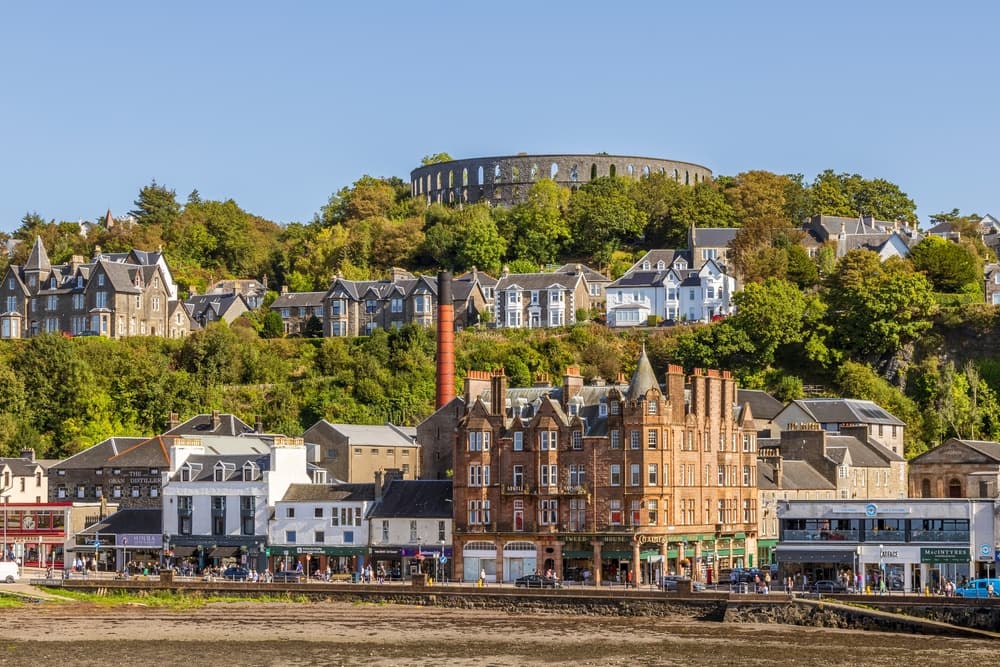
The waterfront is where it all happens: ferry terminals, fishing boats, seafood stalls. Oban Distillery, founded in 1794, occupies a stone building in the heart of town — one of Scotland's smallest and oldest. On the hillside, McCaig's Tower, an unfinished 19th-century colosseum, offers sweeping views over the bay and the islands of Kerrera and Lismore.
History and Context
Oban developed in the 18th century around fishing and maritime trade. The arrival of the railway in 1880 transformed it into a tourist destination and transport hub for the islands. McCaig's Tower was commissioned by banker John Stuart McCaig in the late 19th century, in part to provide work for local craftsmen during winter — construction halted at his death in 1902.
Highlights of Your Visit
McCaig's Tower
This circular pink granite monument dominates the town from Battery Hill. The interior, never completed, is now a public garden. The view over Oban Bay, the ferries and the islands beyond is worth the trip at any time of day.
Oban Distillery
Nestled between the cliff and the waterfront, the distillery produces a single malt with marine notes and a subtle peat character. The guided tour explains the distillation process in small stills, characteristic of this artisanal production.
The Waterfront and Seafood
Oban is renowned for its crustaceans and shellfish. Several stalls and restaurants offer fresh lobster, oysters and prawns directly from the quay. It's one of Scotland's most accessible places to enjoy quality seafood without fuss.
Day Trip to Kerrera Island
A small ferry crosses to this little-visited island in just minutes. You'll find coastal paths, the ruins of 16th-century Gylen Castle and clear views over Oban Bay.
Photography Tips
Sunset from McCaig's Tower is the most photographed moment: the raking light illuminates the bay and CalMac ferries. For the waterfront, morning light is softer and the quays less crowded. The distillery permits photography in common areas; check restrictions during the guided tour.
Location and Access
Oban is on Scotland's west coast, about 2.5 hours' drive from Glasgow. The railway station is just steps from the port. CalMac ferries regularly serve the Isle of Mull, the gateway to Iona, as well as Islay and other Hebridean islands. The town centre is compact and entirely walkable.
Nearby Attractions
- Isle of Mull — Ferry from Oban; wild scenery, Duart Castle and access to Iona.
- Isle of Iona — Medieval abbey and pilgrimage site, accessible via Mull.
- Dunstaffnage Castle — Medieval fortress a few kilometres north of Oban.
- Loch Awe — Large inland loch with the ruins of Kilchurn Castle, east of Oban.
- Glencoe — Iconic Highlands valley, about 1 hour north-east.
Frequently asked questions
From May to September, days are long and ferries to the islands run at full capacity. Summer is peak season: book accommodation and distillery visits in advance. Autumn offers remarkable light and fewer crowds.
During peak season (July-August), online booking is highly advised. Morning slots fill quickly. Outside peak season, walk-ins are often welcome.
Yes, but it's a long day: Oban–Craignure ferry (Mull), drive or bus across Mull, then Fionnphort–Iona ferry. Plan a full day with little free time on the island. Check CalMac schedules before you go.
No, access is free at all times. The walk from the centre takes about ten minutes on foot via sloped lanes.
Yes. The waterfront, seafood stalls, ferry rides and marine wildlife (seals, sometimes dolphins) appeal to children. The town is compact and easy to navigate.
One day is enough to see the town itself. Two nights allow you to add an excursion to Mull, Iona or Kerrera without rushing.
Want to discover this destination?
Our local advisors design your tailor-made trip.