Edinburgh and Lowlands
Scotland's capital perched on a volcanic ridge, the ruined abbeys of the Borders and Glasgow's Mackintosh architecture, to explore over a minimum of five days.
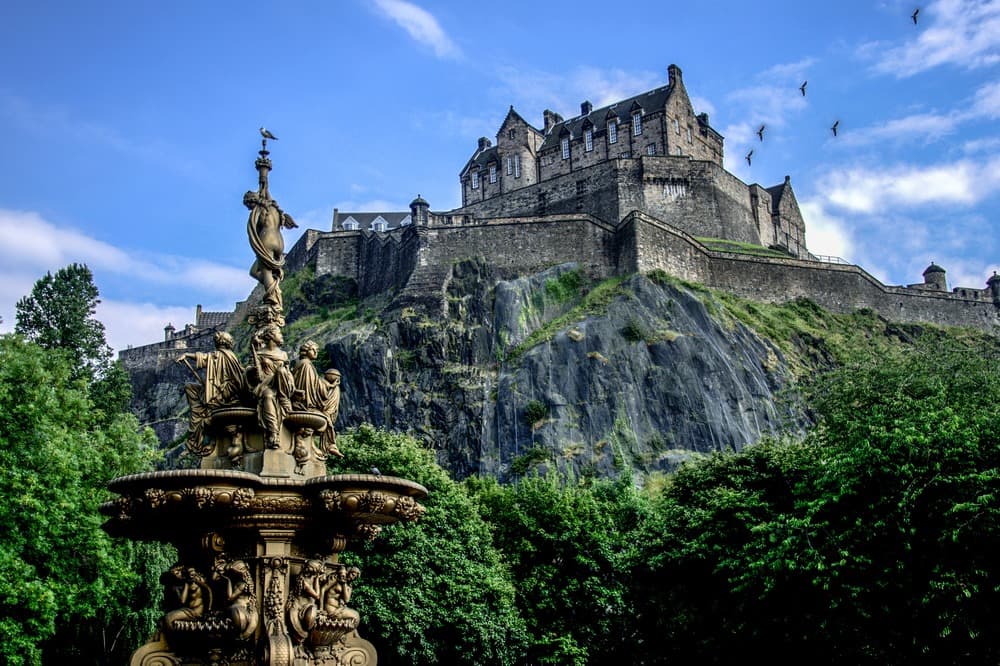
Edinburgh occupies a volcanic ridge carved by glaciers, which explains its singular silhouette: the castle overlooks the city from a 130-metre basalt plug, and the Royal Mile descends in a regular slope down to Holyroodhouse Palace, the official residence of British monarchs in Scotland. This two-kilometre axis concentrates the essence of the medieval old town, with its narrow closes—lateral alleyways where residents once crowded into ten-storey tenements. To the north, separated by Princes Street Gardens laid out on a former drained marsh, the New Town unfolds an orthogonal Georgian plan classified by UNESCO since 1995.
Our agency bases its Scotland trips in Edinburgh for a simple logistical reason: the airport connects some thirty European cities, and the city is the only point in the country where you can combine three days of dense urban exploration with quick access to the Borders, Glasgow, Stirling and the first peaks of the Highlands. The capital has 500,000 inhabitants, yet the scale remains pedestrian. To grasp the city, allow half a day for the castle, one day for the Royal Mile and its museums (National Museum of Scotland, Writers' Museum, Parliament), one day for the New Town, Calton Hill and Dean Village.
South of Edinburgh stretch the Scottish Borders, an agricultural region of rounded hills covered with sheep pastures, crossed by the Tweed. The four great abbeys founded in the 12th century by King David I, at Melrose, Jedburgh, Dryburgh and Kelso, were sacked during the Anglo-Scottish wars and never rebuilt. Their pink sandstone ruins can be visited in a day trip from Edinburgh, in a loop via the A68 and A7. Walter Scott, who partly invented Scotland's romantic imagination, is buried at Dryburgh and his Abbotsford estate near Melrose is open to visitors.
Some 75 kilometres west, Glasgow offers a useful counterpoint to Edinburgh. Once an industrial and port capital, Scotland's second city with 600,000 inhabitants, it has renewed its cultural scene around the architecture of Charles Rennie Mackintosh, a figure of Scottish Art Nouveau: the Glasgow School of Art, the Mackintosh House and the Hill House in Helensburgh summarise his vocabulary. The Kelvingrove Museum and the Burrell Collection, which reopened in 2022, house some of the country's richest collections. The historical rivalry between the two cities is real, their atmospheres differ sharply: Edinburgh is mineral and touristy, Glasgow livelier and more populist.
The climate of the Lowlands is milder than that of the Highlands, with temperatures ranging from 15 to 20°C from June to August, and between 5 and 10°C in winter. Precipitation remains frequent but brief, around 700 mm annually in Edinburgh against over 2000 mm on the west coast of the Highlands. The easterly wind, the haar, can bring morning fog in May and June. At the table, Edinburgh smoked salmon, haggis served with neeps and tatties (swede and mash), and Lanark cheeses pair readily with beers from local breweries such as Innis & Gunn or Williams Bros. Lowland whiskies, from Glenkinchie south of the capital, are lighter and more herbaceous than those from the north.
Beyond the sites, the region is marked by a dense festival calendar in August, when Edinburgh simultaneously hosts the International Festival, the Fringe (independent theatre), the Book Festival and the Military Tattoo on the castle esplanade. The city then doubles in population, accommodation fills up six months in advance and prices soar. Outside this period, the capital returns to its university pace.
To discover
Edinburgh Castle and Royal Mile. Climb up the esplanade to the Honours of Scotland, Scotland's crown jewels, then descend the Royal Mile exploring the medieval closes—those lateral alleyways where you discover courtyards, galleries and old pubs away from the crowds.
Ruined abbeys of the Borders. A day-long loop through Melrose, Dryburgh and Jedburgh, three 12th-century Cistercian and Augustinian abbeys, whose pink sandstone ruins stand amid pastures along the Tweed.
Mackintosh architecture in Glasgow. Visit the Hill House in Helensburgh, restored under a protective metal shell in 2019, and the reconstructed Mackintosh House at the University of Glasgow, to understand the vocabulary of Scottish Art Nouveau.
Hike up Arthur's Seat. A one-hour climb of the 251-metre extinct volcano that dominates Edinburgh from Holyrood Park, with views over the Firth of Forth, the Pentland Hills to the south and the Lomond Hills to the north.
Glenkinchie Distillery. Some 25 km south-east of Edinburgh, tastings at one of the three remaining active Lowland distilleries, whose unpeated single malts contrast with the smoky whiskies of Speyside and Islay.
When to go
The most favourable period runs from May to September, with long days (the sun sets after 10 pm in June thanks to latitude 56° north), temperatures of 15 to 20°C and fully developed vegetation. June and early September offer the best balance between decent weather and moderate crowds. August concentrates festivals in Edinburgh, which makes the city compelling but saturates accommodation and raises rates by 50 to 100 %.
From October to March, temperatures range between 2 and 10°C, showers are more frequent and days are short (nightfall by 4 pm in December). This season remains worthwhile for an urban visit: Edinburgh retains all its interest in the rain, museums and pubs take over, and the city lends itself well to Hogmanay, New Year celebrations. The Border abbeys and Pentland Hills trails are, however, less pleasant between November and February, with waterlogged ground and cold wind.
Practical advice
Allow a minimum of three days in Edinburgh for the old town, the New Town and Arthur's Seat, plus a day dedicated to the Borders and a day in Glasgow if you wish to explore further. Edinburgh Airport, 12 km from the centre by tram, is the logical entry point for the majority of our travellers: it flies direct to Paris, Brussels, Geneva and Montreal in season. Glasgow also has its international airport, useful if your itinerary starts in the west.
The region naturally combines with the central Highlands, two hours' drive via the M9 through Stirling, for an initial 10 to 12-day circuit. Travellers with 15 days or more then continue to the Isle of Skye and the Hebrides, or to the east coast and Speyside for whisky enthusiasts. Edinburgh and the Lowlands suit all profiles, including families with children and more contemplative travellers, as logistics are straightforward, distances short and hotel comfort high, from Border guesthouses to converted Georgian townhouses in the New Town.